
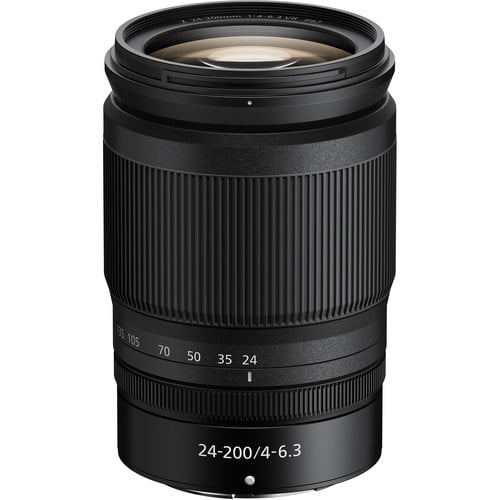
NIKON Z 24-200mm LENS

KSh 128,700.00KSh 145,000.00 (-11%)
- Z-Mount Lens/FX Format
- Aperture Range: f/4 to f/36
- Two ED Elements, Two Aspherical Elements
- One Aspherical ED Element
- ARNEO and Nano Crystal Coatings
- Stepping Motor AF System
- Vibration Reduction Image Stabilization
- Programmable Control Ring
- Weather-Sealed Design, Fluorine Coating
- Rounded 7-Blade Diaphragm
NIKON Z 24-200mm LENS
The Nikon Z 24-200mm f4.0-6.3 VR is the first super-zoom designed for Nikon?s mirrorless cameras with Z-mount and corrected for full-frame sensors. Announced in February 2020, there?s no exact predecessor in Nikon?s F-mount line-up to the new Z-mount lens: Nikon has the AF-S 24-120mm f4.0G ED VR and the AF-S 28-300mm f3.5-5.6G ED VR for their full-frame DSLR cameras. But if you?re coming from a Nikon DX camera and liked the zoom-range of their AF-S DX 18-140mm 3.5-5.6G ED VR the new Z 24-200mm f4.0-6.3 VR covers a similar range on a Nikon full-frame Z camera with an 8 degree wider view on the short end. Together with the not yet available Z 70-200mm f2.8 VR S it?s also the first full-frame Z Nikkor to reach beyond 85mm focal length and to have an optical image stabilization. This makes the new 24-200mm lens also well suited for Nikon?s mirrorless cameras which do not have sensor-based image stabilization like the Z50.
Physically, the Z 24-200mm f4.0-6.3 VR is a very small and lightweight lens making it an ideal travel companion. Even compared to the diminutive Z 24-70mm f4.0 S it is only 73g heavier and 6mm longer ? at 24mm focal length. Combined with a maximum magnification of 1:3.6 at a minimum object distance of 0.7m the lens looks like a real all-rounder ? competing with the Z 24-70mm f4.0 S for best travel zoom. Complementing the new zoom lens with Nikon?s Z 14-30mm f4.0 S to cover the very wide end makes for a lightweight combo of only 1.1kg (2.4 lb.) covering a 14x zoom range.
But the Z 24-200mm f4.0-6.3 VR is also the first full-frame Z-Nikkor without the ?S? in its name signaling that its optical performance is not quite up there with Nikon?s ?S? lenses. In my review of this lens I had a very close look at how good (or bad) Nikon?s new zoom lens really is. So if you?re interested in how Nikon?s first super-zoom for their Z system performs, you?ve come to the right place! PS ? if you?re interested in the other Z lenses mentioned above check out my in-depth Nikon Z 14-30mm f4.0 S review and Nikon Z 24-70mm f4.0 S review.
Facts from the catalog
Let?s compare the new Nikon Z 24-200mm f4.0-6.3 VR (?Z 24-200mm? for short) to Tamron?s 28-200mm f2.8-5.6 Di III (?Tamron?) and Nikon?s Z 24-70mm f4.0 S. The Tamron may look like an odd choice in this comparison as it is currently only available for Sony E-mount. But Tamron has announced that they?ll have Z- and RF-mount versions of their lenses in the future. As usual I?ve rated the features with a [+] (or [++]), when it?s better than average or even state of the art, a [0] if it?s standard or just average, and [-] if there?s a disadvantage.
Size (diameter x length): At 77 x 114mm (3.0 x 4.5in.) the new Z-Nikkor is a pretty slim and short lens. The lens-hood adds 38mm and has a diameter of 97mm. The Tamron is 74 x 117mm (2.9 x 4.6in.) + 28mm lens hood. The Z 24-70mm f4.0 S is 78 x 108mm (3.1 x 4.3in.) + 41mm lens hood at 24mm focal length. When not in use the Z 24-70mm f4.0 S can be collapsed to shave 20mm off its length. All three lenses have a double barrel design and extend when zoomed to their longest focal length: The Z 24-200mm to 215mm, the Tamron to 201mm, the Z 24-70mm f4.0 S to 179mm (with lens hood attached). [+]
Weight: at 565g (19.9 oz.) plus 22g for the lens hood the Z 24-200mm is pretty lightweight. The Tamron is 558g (19.7 oz.) + 25g lens hood, the Z 24-70mm f4.0 S is 497g (17.5 oz.) + 28g lens hood. [+]
Optics: The Z 24-200mm has 19 elements in 15 groups including 2 special dispersion elements and 3 aspherical elements and employs Nikon?s latest ARNEO coating. The Tamron is of a similarly complex construction. The Z 24-70mm f4.0 S is a simpler design with 14 elements in 11 groups. [+]
Focal ratio: The Z 24-200mm starts at f4.0 on the short end, same as the Z 24-70mm f4.0 S but one stop slower than the Tamron. The Z 24-200mm achieves its slowest focal ratio of f6.3 already at 80mm focal length while the Tamron is still one stop brighter at 80mm and slows down to f5.6 from 150mm onward. [-]
Coverage: the 8.3x zoom-range of the Z 24-200mm has the upper hand here over the 7.1x coverage of the Tamron. This gives the Z 24-200mm a 9 degrees wider angle of view on the short end (84 degrees vs. 75 degrees) over the Tamron. The Z 24-70mm f4.0 S naturally is no match for the zooms reaching 200mm focal length. [+]
Closest focus distance of the Z 24-200mm is 0.38m (1.2ft.) at 24mm focal length with a magnification of 1:11.4 and a working distance of 0.25m (9.8in.). At 200mm focal length maximum magnification with manual focus is 1:3.4 which is quite good and results in a working distance of 0.49m (1.6ft.). Minimum object distance of the Tamron is 0.19m (0.6ft.) with a magnification of 1:3.0 and a working distance of only 5 cm (2in.) at 28mm focal length. At 200mm focal length maximum magnification is 1:3.5 at a much more usable working distance of around 0.57m (1.9ft.). The Z 24-70mm f4.0 S achieves a maximum magnification of 1:3.1 at 70mm focal length with 14cm (5.5in.) working distance. A magnification of 1:10 is achieved at the longest focal length at 2.04m (6.7ft.) distance for the Z 24-200mm, 2.07m (6.8ft.) for the Tamron, 0.8m (2.6ft.) for the Z 24-70mm f4.0 S.[+]
Filter-thread: The Z 24-200mm and the Tamron have a 67mm filter-thread. The Z 24-70mm f4.0 S takes 72mm filters. [+]
Image stabilization: The Z 24-200mm offers optical stabilization (VR) which works in conjunction with the body-based stabilization on Nikon?s full-frame Z cameras to achieve a claimed 4.5 stops of stabilization over 5 axes. The Tamron and Nikon?s Z 24-70mm f4.0 S do not offer optical stabilization. Both lenses solely rely on the sensor-based image stabilization of mirrorless cameras. [+]
Auto focus: The new Z 24-200mm comes with built-in AF drive. Manual-focus override is by simply turning the control ring at the back of the lens ? if you didn?t assign another operation to this multi-function ring. The ring has a variable gearing (like Nikon?s other AF Z-Nikkors) which allows for very precise manual focus when turned slowly but cannot be switched to linear gearing. Which makes smooth focus pulling for videographers almost impossible. Same for the Tamron except that the focus ring does just that: focusing. [+]
All three lenses in this comparison cover full frame sensors or can equally be used on a cropped APS-C/DX camera body: the Z 24-200mm on a Z50 is equivalent to a 36-300mm zoom lens on a full-frame camera body. [+]




Reviews
There are no reviews yet.